🏛️
1
Marienplatz
Munich's central square with the world-famous Glockenspiel.
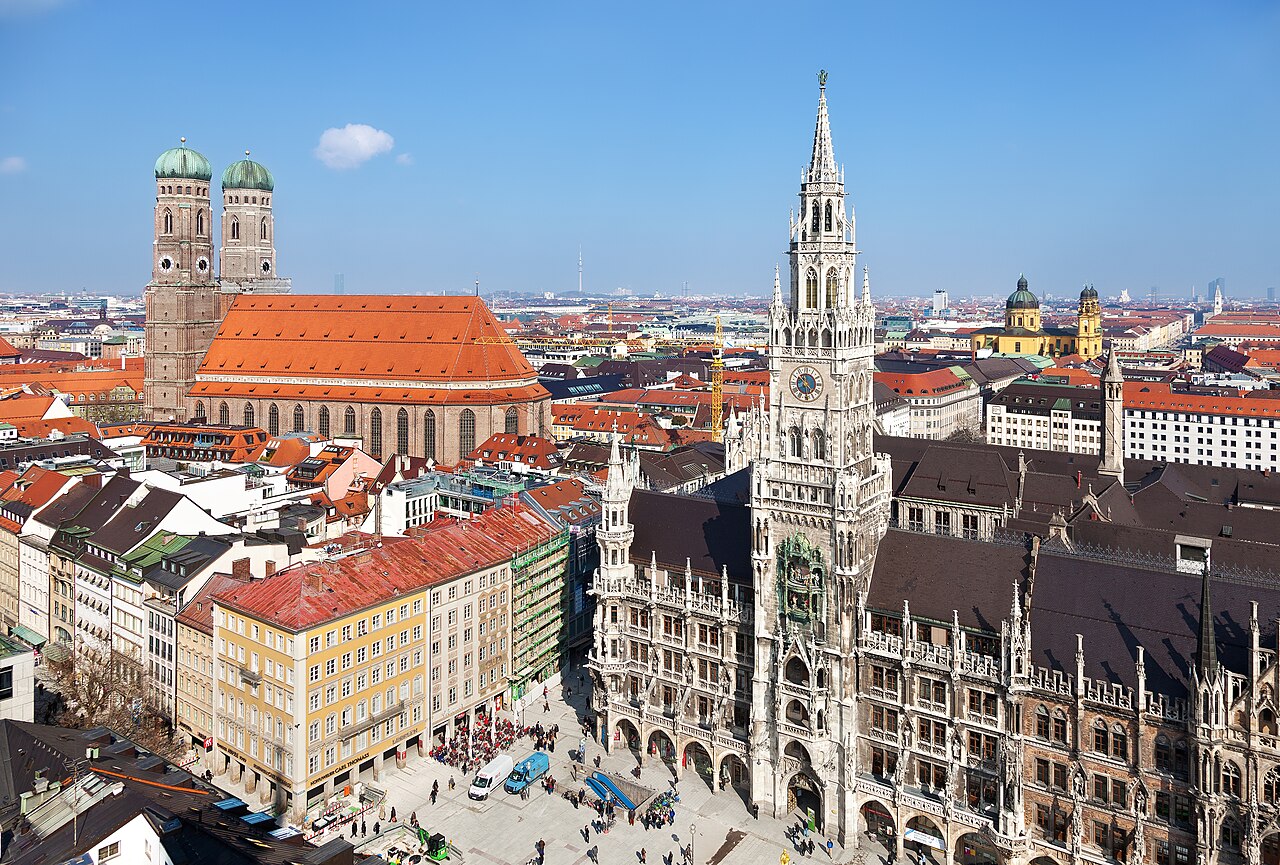
Munich is more than Oktoberfest and lederhosen. In a surprisingly compact space, the city packs in what other metropolises need three times the area for: world-class museums like the Pinakotheken and the Deutsches Museum, one of the largest urban parks in the world — the English Garden, where people surf the Eisbachwelle right in the middle of the city — and a beer-garden culture that turns an afternoon under chestnut trees into a way of life. In between you'll find the Frauenkirche with its onion domes, the Glockenspiel on Marienplatz, and the Viktualienmarkt with Bavarian specialties. Much of it lies within walking distance — the old town is more compact than Munich's reputation suggests. This walking tour shows you why Munich ranks among Europe's most visited cities, without you having to read up on it for days.

A cosmopolitan city with heart. Beer, art and mountains.
Hand-picked stops, connected into one optimized loop.
Not your thing? Drop any spot you like — Stubbs reworks the route instantly.
In the preview, Stubbs flies the loop first as a 3D flyover.
Stubbs files every place into a category — so you can see at a glance what to expect.
If you only have half a day — these are the spots you have to see.
Munich's central square with the world-famous Glockenspiel.
One of the largest urban parks in the world — with surfing on the Eisbachwelle.
Munich's daily open-air market with Bavarian specialties since 1807.
Munich's landmark with its distinctive onion domes.
The world's most famous beer hall since 1589.
Stubbs plans breaks into the route: café, restaurant or bar, each at the start, in the middle or at the end of the loop. For this tour, Stubbs suggested for example:
After about 60 minutes, between Alte Pinakothek and Karlstor (München).
In the 3D flyover, swipe on to: Museumscafe · Cafe Arnold
After about 95 minutes, between Sankt Johann Nepomuk / Asam Church and Frauenkirche.
In the 3D flyover, swipe on to: Unter Deck · Kilians
The breaks do not make the walk any longer: Stubbs rearranges the stops around them. Example from 9 October 2026. Which places Stubbs suggests depends on your starting point, the day and opening hours; you choose the kind and timing. Places from OpenStreetMap.
Stubbs tailors the stops, the starting point and the timing to you — in seconds. A guided city tour costs 15–20 € per person; Stubbs guides you for free.

Munich's old town is best experienced on foot. Mapped by Stubbs builds a handpicked walking tour: Marienplatz, the Frauenkirche, the English Garden, the Viktualienmarkt and more highlights are linked into an optimized route based on your interests.
Free, no booking, ready in seconds. Stubbs knows the hidden corners — from the Hofgarten to Maximilianstraße to the Eisbachwelle in the English Garden — and guides you along the prettiest route to your next stop. Ideal for a weekend in Bavaria, a city break or as the kickoff to an Alpine trip.
The Munich walking tour on your smartphone works for all ages and can be adapted anytime to the time you have. You choose which categories you want to see — from highlights and local favorites to cafés and beyond-the-city spots like the Olympiapark.
Getting there and best time to visit: Munich is one of Germany's most important rail hubs — the Hauptbahnhof is just a few minutes' walk from Karlsplatz and the old town. By ICE you're here from Nuremberg in a good hour, from Stuttgart in a good two and from Berlin in around four; from the airport the S-Bahn brings you into the center in about 40 minutes. The loveliest time for a city walk is May to October, when the beer gardens are open — only during Oktoberfest in late September is the city noticeably busier and accommodations much more in demand. On weekdays you'll experience Marienplatz and the Viktualienmarkt more calmly than on weekends.
What makes Munich special: the beer garden culture, where you're traditionally allowed to bring your own Brotzeit and strangers happily share a table. The Eisbachwelle at the southern edge of the English Garden, where surfers ride a standing river wave in the middle of the big city almost year-round — a sight you'll find almost nowhere else. And a museum landscape of rare density: the Pinakotheken in the Kunstareal span the arc from Dürer to the present, and the Deutsches Museum on the Museumsinsel ranks among the largest science and technology museums in the world. In between, Alpine views when the Föhn blows and a cityscape that, despite its million-strong scale, feels remarkably laid-back.