🏛️
1
Kaiserburg
Medieval castle complex above the old town — for centuries a residence of the Holy Roman emperors.
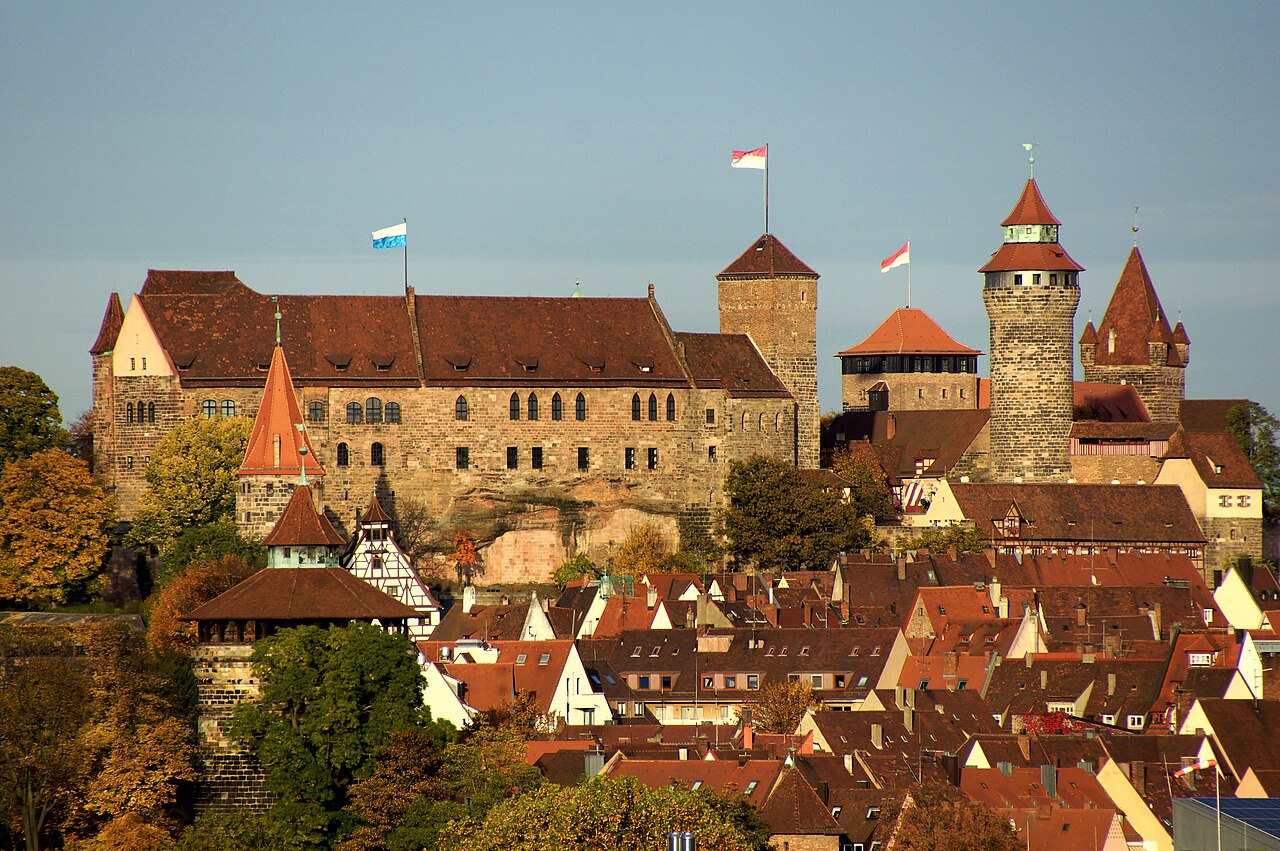
Nuremberg was once something like the unofficial capital of the Holy Roman Empire: the emperors resided at the Kaiserburg, and in the lanes below worked Albrecht Dürer, Veit Stoß and the finest craftsmen of their day. The Second World War devastated the old town, but Nuremberg rebuilt its center with care — today the city stretches from the castle hill across the Hauptmarkt with the Schöner Brunnen to the two great Gothic churches, St. Sebald and St. Lorenz, with the Pegnitz and the Henkersteg in between. And the city confronts its entire history, the dark chapters included — the Dokumentationszentrum Reichsparteitagsgelände is one of the country's most important places to learn. Compact enough for a city walk, the old town certainly is.

One imperial castle. Three in a Weggla. A thousand years of history.
Hand-picked stops, connected into one optimized loop.
Not your thing? Drop any spot you like — Stubbs reworks the route instantly.
In the preview, Stubbs flies the loop first as a 3D flyover.
Stubbs files every place into a category — so you can see at a glance what to expect.
If you only have half a day — these are the spots you have to see.
Medieval castle complex above the old town — for centuries a residence of the Holy Roman emperors.
Central market square with the delicate Gothic fountain and the golden lucky ring.
The painter's half-timbered house by the Tiergärtnertor, now a museum.
Gothic church with the Angelic Salutation by Veit Stoß.
Craft lanes in a historic setting right by the Königstor.
Stubbs plans breaks into the route: café, restaurant or bar, each at the start, in the middle or at the end of the loop. For this tour, Stubbs suggested for example:
After about 35 minutes, between Weinstadel and Karlsbrücke (Nuremberg).
In the 3D flyover, swipe on to: Di Simo · Pique Nique
After about 60 minutes.
In the 3D flyover, swipe on to: Finnegan's Harp · Club #Schimanski
With the breaks, the walk gets 2 min longer. Example from 9 October 2026. Which places Stubbs suggests depends on your starting point, the day and opening hours; you choose the kind and timing. Places from OpenStreetMap.
Stubbs tailors the stops, the starting point and the timing to you — in seconds. A guided city tour costs 15–20 € per person; Stubbs guides you for free.

Nuremberg's old town beneath the Kaiserburg is best experienced on foot. Mapped by Stubbs creates a handpicked walking tour: the Kaiserburg, the Hauptmarkt with the Schöner Brunnen, the Albrecht-Dürer-Haus, St. Lorenz and other highlights are linked into an optimized route based on your interests.
Free, no booking, ready in seconds. Stubbs knows the hidden corners — from the Weißgerbergasse with its half-timbered facades to the Henkersteg on the Pegnitz and the Tiergärtnertorplatz, where half the old town gathers in the evening — and guides you along the loveliest route to the next stop. Ideal for a weekend in Franconia, a city break or combined with a side trip to Bamberg.
The Nuremberg walking tour on your smartphone suits all ages and can be adjusted at any time to the time you have available. Choose for yourself which categories you want to see — from highlights and local favorites to cafés and spots beyond the city like the Dokumentationszentrum Reichsparteitagsgelände.
Getting there and the best time to visit: Nuremberg is one of the most important rail hubs in southern Germany — from Munich you're there in a good hour by ICE, from Würzburg in about an hour, from Frankfurt in a good two hours; Bamberg is around 40–60 minutes away. From the Hauptbahnhof, a few minutes' walk brings you to the Königstor right at the edge of the old town. Nuremberg is at its finest from May to October, when the squares and the banks of the Pegnitz are buzzing. In Advent the Christkindlesmarkt transforms the Hauptmarkt into one of the most famous Christmas markets in the world — full of atmosphere, but correspondingly crowded.
What makes Nuremberg special: the Kaiserburg, where the Holy Roman emperors stopped for centuries — from the Burgfreiung you get the best view over the rooftops of the old town. Albrecht Dürer, the city's most famous son, whose half-timbered home at the Tiergärtnertor still stands today. The Nürnberger Rostbratwurst, small, grilled over beechwood and classically served three in a Weggla, alongside the Lebkuchen tradition of the old trading city. And its honest reckoning with its own past: from medieval splendor to the Dokumentationszentrum Reichsparteitagsgelände, Nuremberg tells German history as completely as almost no other city.