🏛️
1
Frauenkirche
Baroque domed church on the Neumarkt, faithfully rebuilt after its destruction in 1945 and consecrated in 2005.
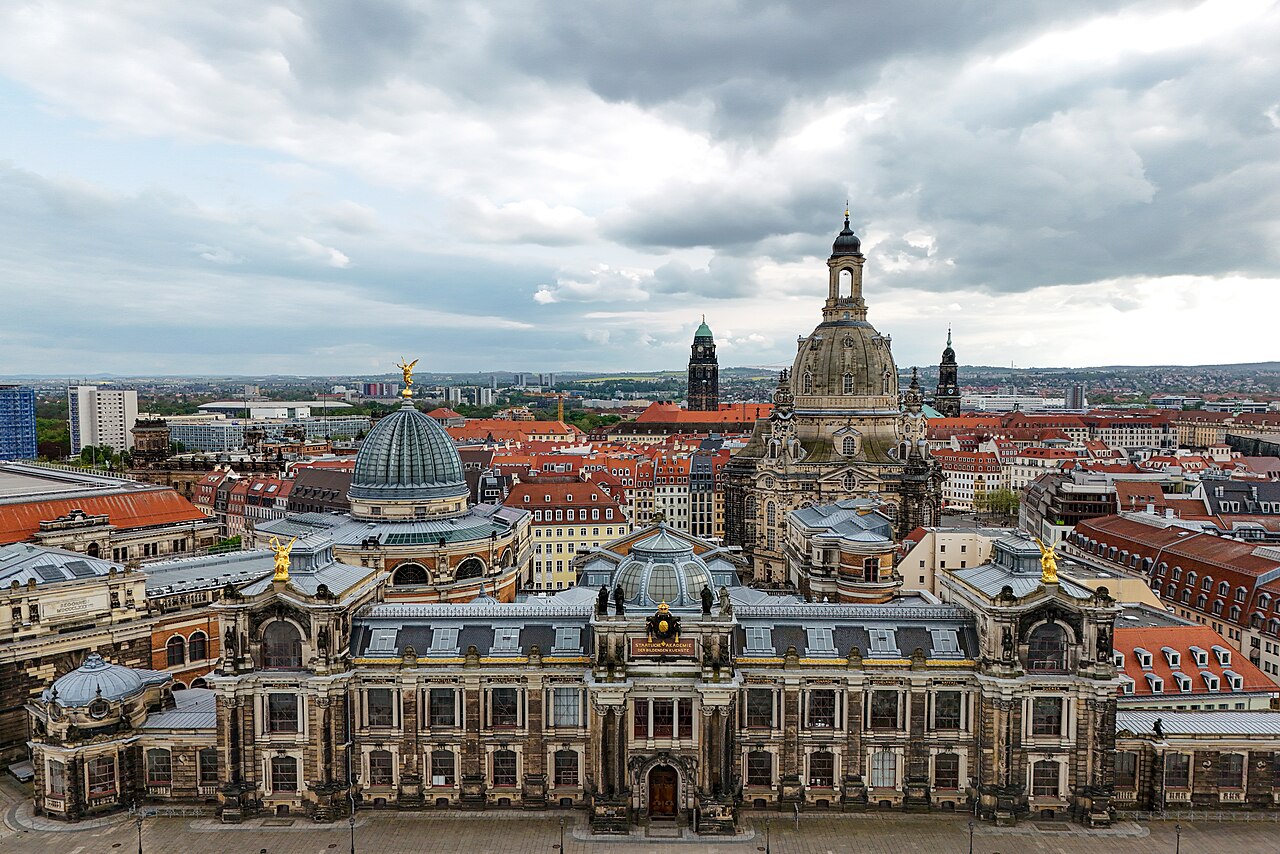
Dresden is the story of a return. The old town, almost entirely destroyed in February 1945, stands again today — rebuilt stone by stone, above all the Frauenkirche, whose reconstruction was completed in 2005 and in whose façade the dark original stones remain visible to this day. All around, within a few hundred meters, sits everything that earned Dresden the name Florence on the Elbe: the Zwinger with the Gemäldegalerie Alte Meister, the Semperoper on Theaterplatz, the Residenzschloss with the Grünes Gewölbe, plus the Brühlsche Terrasse high above the Elbe. And if you cross the river, you'll find the counterprogram in the Äußere Neustadt: a hip quarter, backyard art, Gründerzeit architecture. This walking tour connects both — on routes short enough for a single day.

One dome. One Zwinger. One Florence on the Elbe.
Hand-picked stops, connected into one optimized loop.
Not your thing? Drop any spot you like — Stubbs reworks the route instantly.
In the preview, Stubbs flies the loop first as a 3D flyover.
Stubbs files every place into a category — so you can see at a glance what to expect.
If you only have half a day — these are the spots you have to see.
Baroque domed church on the Neumarkt, faithfully rebuilt after its destruction in 1945 and consecrated in 2005.
Baroque palace complex with the Gemäldegalerie Alte Meister and porcelain collection.
World-famous opera house on Theaterplatz, named after architect Gottfried Semper.
Riverside promenade high above the Elbe, known since the 19th century as the "Balcony of Europe".
Former residence of the Saxon electors, home to the Grünes Gewölbe.
Stubbs plans breaks into the route: café, restaurant or bar, each at the start, in the middle or at the end of the loop. For this tour, Stubbs suggested for example:
After about 25 minutes, between Golden Rider and Zwinger.
In the 3D flyover, swipe on to: Camondas Schokoladen-Café · Apotheke im Taschenbergpalais
After about 50 minutes, between Dresden Cathedral and Kreuzkirche.
In the 3D flyover, swipe on to: Bistro Ecke Frauenkirche · The Shamrock
With the breaks, the walk gets 2 min longer. Example from 9 October 2026. Which places Stubbs suggests depends on your starting point, the day and opening hours; you choose the kind and timing. Places from OpenStreetMap.
Stubbs tailors the stops, the starting point and the timing to you — in seconds. A guided city tour costs 15–20 € per person; Stubbs guides you for free.

Dresden's baroque old town on the Elbe is best experienced on foot. Mapped by Stubbs builds a hand-picked walking tour: the Frauenkirche, the Zwinger, the Semperoper, the Brühlsche Terrasse and more highlights, linked into an optimized route based on your interests.
Free, no booking, ready in seconds. Stubbs knows the hidden corners — from the Kunsthofpassage in the Neustadt to the Yenidze, the former cigarette factory built like a mosque, to the Elbwiesen with their view of the old town skyline — and guides you along the loveliest route to your next stop. Perfect for a weekend in Saxony, a city break from Berlin, or as the kickoff to a trip into Saxon Switzerland.
The Dresden walking tour on your smartphone suits all ages and can be adapted to the time you have at any moment. Choose which categories you want to see — from highlights and local favorites to cafés and spots beyond the city like the Elbschlösser or the Blaues Wunder.
Getting there and the best time to visit: Dresden is well connected by rail — you're there from Berlin in around two hours, from Leipzig in just over an hour, and direct trains run through the Elbe valley from Prague too. From the main station it's about a quarter of an hour on foot along the Prager Straße to the old town. The finest time for a walking tour is May to October, when the Elbwiesen and the Brühlsche Terrasse are in their best light. Advent has a charm all its own thanks to the Striezelmarkt, one of Germany's oldest Christmas markets — though that's also when the old town is at its busiest.
What makes Dresden special: the density of world-class art — the Zwinger holds Raphael's Sistine Madonna, the Residenzschloss dazzles with the Grünes Gewölbe, the baroque treasury of the Saxon electors, and the Albertinum spans the arc from Caspar David Friedrich to the present. The Fürstenzug, at around 100 meters one of the largest porcelain murals in the world, survived the destruction of 1945 almost unscathed. And then there's the view from the far bank of the Elbe: the skyline of domes, towers and terraced riverbank is essentially the same one Canaletto painted in the 18th century — to this day it's called the Canaletto view.