🏛️
1
Plönlein
Famous half-timbered ensemble between the Siebersturm and Kobolzeller Tor — Rothenburg's picture-postcard scene.
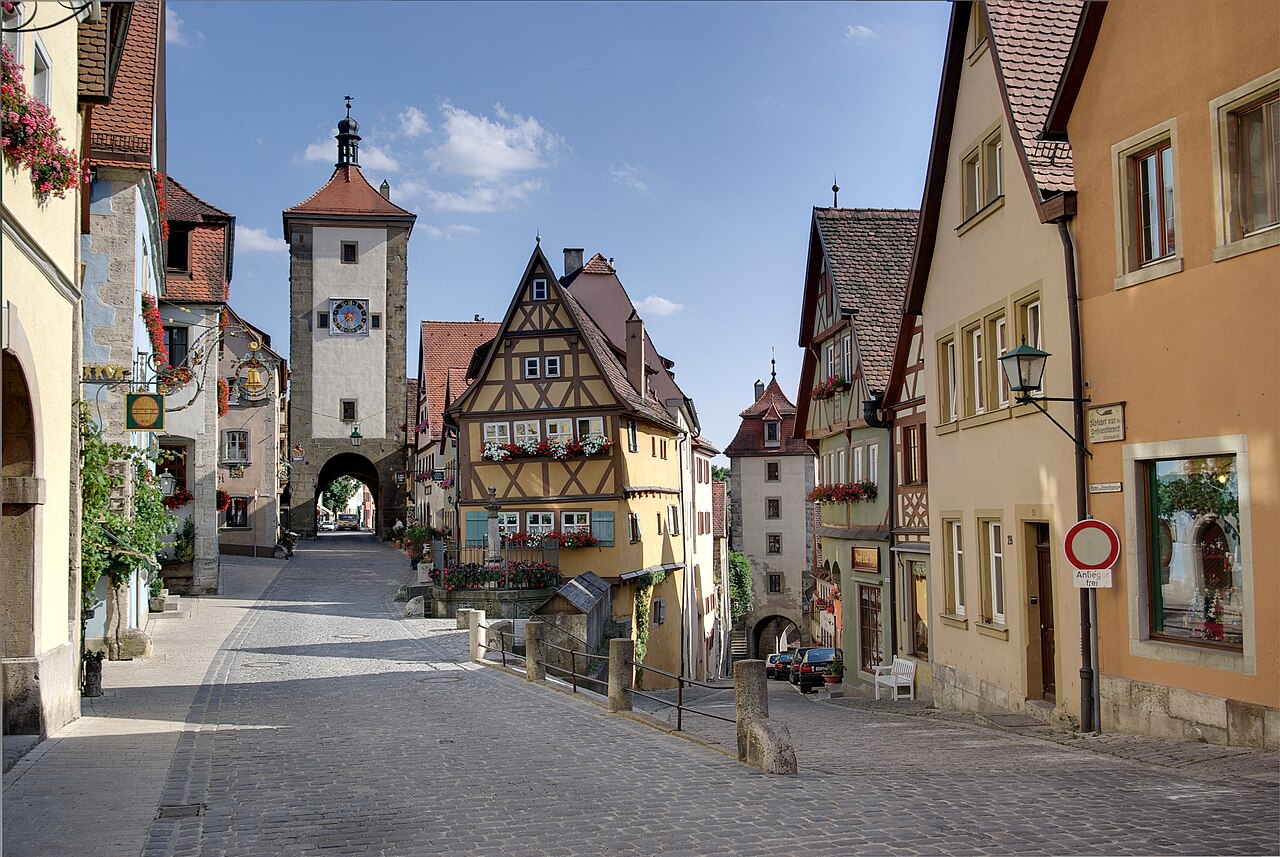
Rothenburg ob der Tauber is the Middle Ages just as you picture them — only real. After the Thirty Years' War, the once-proud imperial city fell so deeply into poverty that there was simply no money for new buildings; that very fact saved its townscape. Today you stand at the Plönlein among half-timbered gables and towers like something out of a film set, walk the covered rampart of the almost fully preserved town wall around the old town, and look out from the Burggarten far down into the Tauber valley. Inside St. Jakob, the Heilig-Blut-Altar awaits — a masterpiece by Tilman Riemenschneider. And because the whole old town measures barely a kilometer across, all of it lies just minutes apart on foot — perfect for a walking tour that feels like a journey through time.

One wall. One Plönlein. The Middle Ages, for real.
Hand-picked stops, connected into one optimized loop.
Not your thing? Drop any spot you like — Stubbs reworks the route instantly.
In the preview, Stubbs flies the loop first as a 3D flyover.
Stubbs files every place into a category — so you can see at a glance what to expect.
If you only have half a day — these are the spots you have to see.
Famous half-timbered ensemble between the Siebersturm and Kobolzeller Tor — Rothenburg's picture-postcard scene.
The heart of the old town, with its Renaissance town hall and a viewing platform atop the town hall tower.
A largely preserved medieval fortification with a walkable rampart and numerous towers.
A garden on the grounds of the former castle, with sweeping views over the Tauber valley.
Gothic church with the Heilig-Blut-Altar by Tilman Riemenschneider.
Stubbs plans breaks into the route: café, restaurant or bar, each at the start, in the middle or at the end of the loop. For this tour, Stubbs suggested for example:
After about 60 minutes, between Spitalbastei and Plönlein, Laufbrunnen.
Outdoor seating and vegan dishes.
In the 3D flyover, swipe on to: Weinstube Löchle · Paula's Biergarten (Hotel Eisenhut)
The breaks do not make the walk any longer: Stubbs rearranges the stops around them. Example from 9 October 2026. Which places Stubbs suggests depends on your starting point, the day and opening hours; you choose the kind and timing. Places from OpenStreetMap.
Stubbs tailors the stops, the starting point and the timing to you — in seconds. A guided city tour costs 15–20 € per person; Stubbs guides you for free.

Rothenburg ob der Tauber is best experienced on foot. Mapped by Stubbs creates a handpicked walking tour: the Plönlein, the market square with its town hall, the town wall, the Burggarten, St. Jakob and other highlights are connected into an optimized route based on your interests.
Free, no booking, ready in seconds. Stubbs knows the hidden corners — from the Gerlachschmiede with its striking half-timbered gable to the quiet monastery garden by the RothenburgMuseum and the Doppelbrücke down in the Tauber valley — and leads you along the prettiest route to your next stop. Perfect for a day trip from Würzburg or Nuremberg, or as the highlight of a drive along the Romantische Straße.
The Rothenburg ob der Tauber walking tour on your smartphone suits all ages and can be adapted at any time to the time you have available. Choose for yourself which categories you'd like to see — from highlights and local favorites to cafés and spots beyond the city like the Tauber valley with the Doppelbrücke.
Getting there and the best time to visit: you can reach Rothenburg by train via the Steinach junction — from Würzburg you're there in a little over an hour, from Nuremberg in about an hour and a half, each with a short change. From the station it's just a few minutes on foot to the Rödertor. Rothenburg is loveliest early in the morning and in the evening, once the day-trippers have gone — and in spring and fall it's more relaxed during the day than in high summer, too. Advent with the Reiterlesmarkt is the most atmospheric but also the most sought-after time; if you come then, it's best to stay overnight.
What makes Rothenburg special: the town wall, which still almost completely encloses the old town — along the covered rampart you can walk much of the loop up over the rooftops, past towers and gates. The Heilig-Blut-Altar in St. Jakob, carved by Tilman Riemenschneider in the early 16th century, ranks among the most important works of German woodcarving. And the setting: the old town sits high above the Tauber valley, and if you descend from the Burggarten, you'll find mills, meadows and the stone Doppelbrücke below — a second, quieter world just a few minutes beneath the lanes.