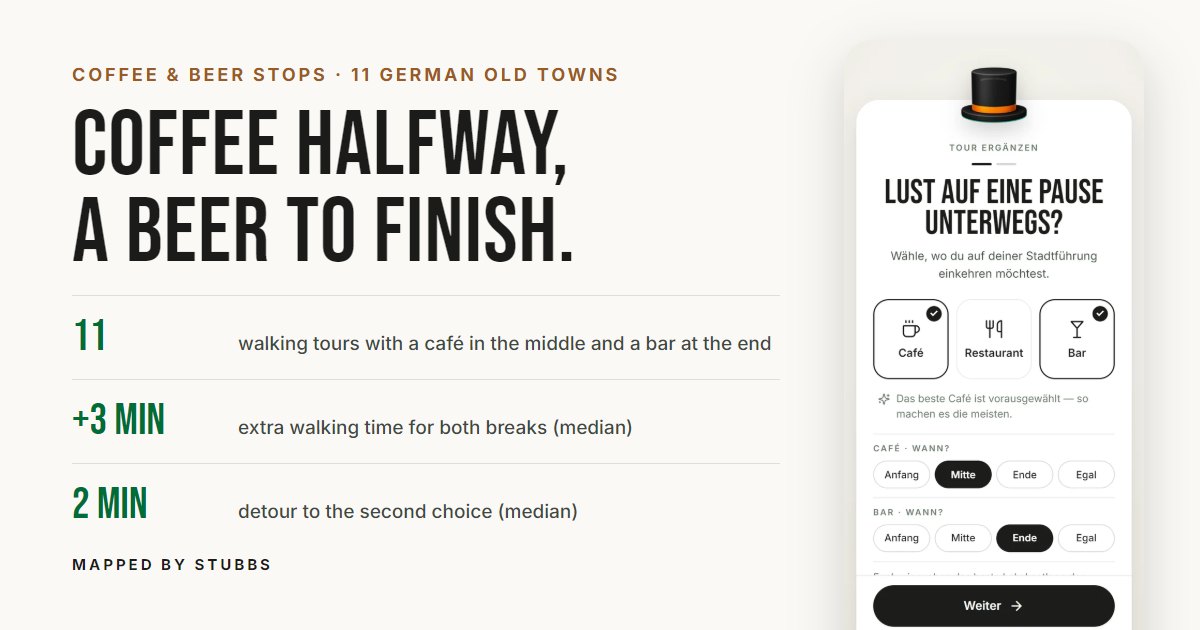
What this is about: Stubbs now plans breaks into the walking tour itself. We tried it on eleven German old-town loops: a café in the middle, a bar at the end. Two breaks added a median of 3 minutes of walking. Coffee came after a median of 45 minutes. And in eight of eleven cities the walk ends with beer from a brewery, a brewery tap or a beer garden.
After an hour in an old town comes the moment you want to sit down. In most city guide apps that means leaving the route, searching the map for a café, reading reviews and finding your way back. The walk you end up doing is rarely the one you planned.
So Stubbs asks before you start. Once the tour is planned, you choose café, restaurant or bar and say when for each: at the start, in the middle or at the end of the loop. Stubbs finds the place and arranges the loop around it. We wanted to know what that means in real cities. How much longer does the walk get? When does the coffee come? And where do you end up?
The results in short: Eleven German old-town loops, each with a café in the middle and a bar at the end. Extra walking time for both breaks: a median of 3 minutes, at most 5 in seven cities. Coffee break: after a median of 45 minutes. Detour to the second choice: a median of 2 minutes. In eight of eleven cities the final bar is a brewery, a brewery tap or a beer garden.
All eleven loops at a glance
| City | Walking time | Café (middle) | Bar (end) | Extra |
|---|---|---|---|---|
| Dresden | 79 → 78 min | 451after ~45 min | Bistro Ecke Frauenkirche | −1 min |
| Nuremberg | 76 → 77 min | Café Beerafter ~45 min | la bas | +1 min |
| Hamburg | 169 → 171 min | Galerie & Café Seeterrassenafter ~75 min | Whiskyplaza im alten Hamburger Aalspeicher | +2 min |
| Heidelberg | 110 → 112 min | Frollein Bentafter ~40 min | Vetter Alt-Heidelberger Brauhaus | +2 min |
| Munich | 92 → 94 min | Cafe Luitpold – Palmengartenafter ~40 min | Augustiner Stehausschank | +2 min |
| Bamberg | 49 → 52 min | Café Marleafter ~40 min | Schlenkerla Biergarten | +3 min |
| Rothenburg o. d. T. | 63 → 67 min | Café Lebenslustafter ~20 min | Paula's Biergarten (Hotel Eisenhut) | +4 min |
| Cologne | 85 → 91 min | Chocolat Grand Caféafter ~50 min | Brauerei Zur Malzmühle | +6 min |
| Lubeck | 86 → 93 min | Maraeafter ~45 min | Brauberger | +7 min |
| Regensburg | 77 → 97 min | Café Prinzessafter ~55 min | Spitalgarten | +20 min |
| Freiburg | 111 → 136 min | Café Inklusivafter ~115 min | Hausbrauerei Feierling | +25 min |
Walking time: pure walking time of the loop without breaks → with breaks, not counting time spent inside. “After ~… min”: approximate walking time to the café, estimated from the share of the distance and rounded to 5 minutes. Sorted by extra walking time. Each city links to its city page with an example and the “Start tour with a break” button.
How we measured
- The loops are our ready-made walking tours. Each of the eleven cities has a city page on with-stubbs.com with an old-town loop that ends where it starts. We used exactly those loops.
- The request is the same as in the app: a café for the middle, a bar for the end, planned for another day. Opening hours count as a plus but rule nothing out. If you set off today, places listed as closed at your arrival time are left out.
- The places come from OpenStreetMap. Stubbs filters out chains such as McDonald’s or Starbucks and places without a name. From the rest, a language model (Claude by Anthropic) picks the best three of each kind; the first becomes the break, the other two are the alternatives. Stubbs checks the short descriptions against the source data.
- We measured on 9 October 2026, once per city. Walking times before and after come from the pedestrian routing the navigation also uses.
For Stubbs, “middle” means roughly after the first and before the last third of the stops. If the first stops are close together, the coffee break can come after just 20 minutes (Rothenburg) or late: in Freiburg after the Schlossberg, after almost two hours.
What stands out
1. Two breaks cost almost no time
In seven of eleven cities the café and the bar make the loop at most 5 minutes longer, and in Dresden it even gets a minute shorter. That is because Stubbs does not just tack on two stops. The break goes into the chosen third of the loop, where the detour is shortest, and then Stubbs reorders stops and breaks together. In an old town there is almost always a café on the way.
2. Ending at the brewery
For the final bar Stubbs could choose from cocktail bars, wine bars, pubs and beer gardens. In eight of eleven cities it landed on beer on tap: the Schlenkerla beer garden with its smoked beer in Bamberg, the Kölsch brewery Zur Malzmühle in Cologne, Hausbrauerei Feierling in Freiburg, Vetter Alt-Heidelberger Brauhaus in Heidelberg, the brewpub Brauberger in Lubeck, the Augustiner Stehausschank in Munich, plus the beer gardens Spitalgarten in Regensburg and Paula's Biergarten in Rothenburg. The exceptions are Hamburg, with a whisky bar in an old eel store, Dresden and Nuremberg.
3. The alternatives are around the corner
Every break comes with two alternatives of the same kind. Their detour was a median of 2 minutes, and at most 3 minutes for six in ten. If you don’t like the suggested café, the second one costs you hardly any time. In Regensburg, the alternative to Café Prinzess, which according to the source data opened in 1686 as one of the first coffee houses in southern Germany, is Das Degginger, with no detour.
4. Two outliers
In Regensburg the loop gets 20 minutes longer. One reason: the Spitalgarten is on the other bank of the Danube, so the loop crosses the Stone Bridge and comes back. If you don’t want that, swipe to the alternative Bischofshof am Dom in the flyover, also with no detour. In Freiburg 1.7 kilometres and 25 minutes were added. Both cases show the limit: Stubbs takes the best place in the chosen third, even if it is not right on the route. You see the walking time before you start and can swap.

How to plan breaks yourself
After planning, Stubbs asks whether you fancy a break along the way. You choose one or more kinds and a timing for each. “Any” means the best place on the whole loop, wherever it is.
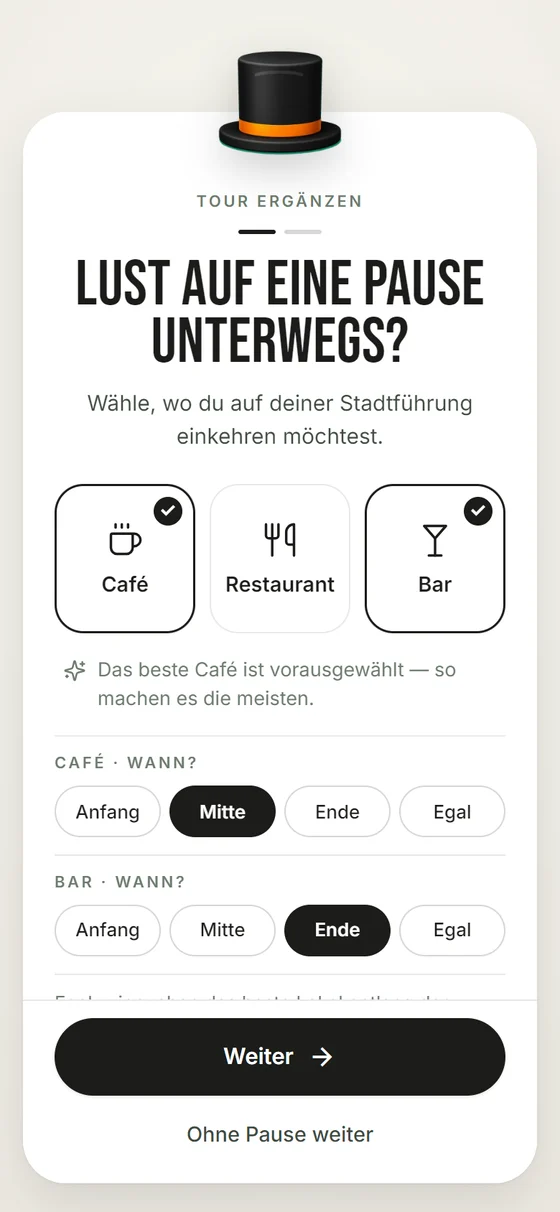
Café in the middle, bar at the end: the request behind this analysis (German interface).
Then the 3D flyover flies the loop. At every break you swipe sideways on the card to see the alternatives and their detour in minutes. “Instead” swaps the place, “Add too” takes a second break along. On the eleven city pages this works with the ready-made loop as well: the “Start tour with a break” button opens it with the same question.
What this analysis cannot tell you
- It is a snapshot. One measurement per city on one day. If you plan the same loop today you may get different places, especially if you set off right away and Stubbs checks opening hours.
- It is not a restaurant review. We tasted nothing. The choice depends on what is mapped in OpenStreetMap, and small places without an entry are missing.
- The loop with breaks is redrawn. The small detours through parks and along rivers that Stubbs adds in the first plan are dropped. A minute or two of the difference can come from that, in either direction.
- Time inside does not count. The table only shows how much longer the walk gets. A coffee takes as long as you like.
Frequently asked questions
Is there a walking tour app that plans breaks into the route?
Yes, Mapped by Stubbs. You pick café, restaurant or bar and, for each, whether the break should be at the start, in the middle or at the end of the loop. The place goes where the detour is shortest, and two alternatives come with it. In our app comparison Stubbs is the only one of five apps that does this.
How much longer does a walking tour get with two breaks?
Across our eleven loops, a median of 3 minutes of walking, at most 5 in seven cities. The outliers were Regensburg with 20 and Freiburg with 25 minutes.
Where can I end a German old-town walk with beer from a brewery?
Stubbs planned the Schlenkerla in Bamberg, Brauerei Zur Malzmühle in Cologne, Hausbrauerei Feierling in Freiburg, Vetter Alt-Heidelberger Brauhaus in Heidelberg and Brauberger in Lubeck.
How was this measured?
On 9 October 2026 we requested a café for the middle and a bar for the end of the ready-made old-town loops of eleven German cities, through the app’s own interface, and compared the walking time before and after.